Monday, December 24, 2007

The ox and the ass


We often hear about the Ox and the Ass around Chrismastide. We hear the familiar tune and lyric of "Good Christian Men Rejoice" with the old reference to the Ox and Ass.

In the Orthodox nativity icon, we often see an ox and ass. I learned today that these are not merely decorative images of a full stable. Rather, they are part of an understanding of prophetic utterance.

The prophet Isaiah, some 700 years before Christ, prophesied:

2 Hear, O ye heavens, and give ear, O earth, for the Lord hath spoken. I have brought up children, and exalted them: but they have despised me. 3 The ox knoweth his owner, and the ass his master's crib: but Israel hath not known me, and my people hath not understood.

Christ is born . . . Glorify Him!

Monday, November 12, 2007

For my Marine Corps brothers

Insensibility

I
Happy are men who yet before they are killed
Can let their veins run cold.
Whom no compassion fleers
Or makes their feet
Sore on the alleys cobbled with their brothers.
The front line withers,
But they are troops who fade, not flowers
For poets’ tearful fooling:
Men, gaps for filling:
Losses, who might have fought
Longer; but no one bothers.

II
And some cease feeling
Even themselves or for themselves.
Dullness best solves
The tease and doubt of shelling,
And Chance’s strange arithmetic
Comes simpler than the reckoning of their shilling.
They keep no check on armies’ decimation.

III
Happy are these who lose imagination:
They have enough to carry with ammunition.
Their spirit drags no pack.
Their old wounds, save with cold, can not more ache.
Having seen all things red,
Their eyes are rid
Of the hurt of the colour of blood forever.
And terror’s first constriction over,
Their hearts remain small-drawn.
Their senses in some scorching cautery of battle
Now long since ironed,
Can laugh among the dying, unconcerned.

IV
Happy the soldier home, with not a notion
How somewhere, every dawn, some men attack,
And many sighs are drained.
Happy the lad whose mind was never trained:
His days are worth forgetting more than not.
He sings along the march
Which we march taciturn, because of dusk,
The long, forlorn, relentless trend
From larger day to huger night.

V
We wise, who with a thought besmirch
Blood over all our soul,
How should we see our task
But through his blunt and lashless eyes?
Alive, he is not vital overmuch;
Dying, not mortal overmuch;
Nor sad, nor proud,
Nor curious at all.
He cannot tell
Old men’s placidity from his.

VI
But cursed are dullards whom no cannon stuns,
That they should be as stones;
Wretched are they, and mean
With paucity that never was simplicity.
By choice they made themselves immune
To pity and whatever moans in man
Before the last sea and the hapless stars;
Whatever mourns when many leave these shores;
Whatever shares
The eternal reciprocity of tears.

- Wilfred Owen

Wednesday, July 11, 2007

The Omega and the Alpha

After completing forty years of sojourn in this world, I was, in some small, given a foretaste and admission to paradise this past Sunday upon my reception to the Orthodox Catholic Church. That which I shared from St. Ephrem the Syrian near the beginning of this blog is applicable also to us all as we come to the faith, I think:

The thief gained the faith which gained him,
And brought him up and placed him in paradise.
He saw in the Cross a tree of life;
That was the fruit,
He was the eater in Adam's stead.
The fool, who goes astray,
Grazes the faith, as it were an eye,
By all manner of questions.
The probing of the finger blinds the eye,
And much more doth that prying blind the faith.
For even the diver pries not into his pearl.
In it do all merchants rejoice
Without prying into whence it came;
Even the king who is crowned therewith
Does not explore it.


As we sing in the liturgy: "But like the theif will I confess thee: Remember me, O Lord, in Thy kingdom."

Thus, my soujourn in the desert has come to a close. I enter the promised land, but like the Hebrews of old, that is not the end of the story, but the beginning - only the end of the prologue, perhaps.

A wise priest of whom I asked for prayers at the time of preparation for confession and chrismation did not offer them in response, but did offer a general remark to a wider audience that I took as his response to me: that too many talked of larger things as if they were Church Fathers rather than minding the little things required of the daily Christian walk. It was an excellent reminder and rebuke, even if not directly intended for me. Too often, even by simply quoting from the Fathers that which I thought profitable to quote, I have overspent on larger things than small things.

Today my father-in-law stands at the very threshhold of death. Yesterday I talked to him of little things and ultimate things, and perhaps despite the coma, somewhere, he heard me. I read to him from Revelation Chapter 21:

Now I saw a new heaven and a new earth, for the first heaven and the first earth had passed away. Also there was no more sea. Then I, John, saw the holy city, New Jerusalem, coming down out of heaven from God, prepared as a bride adorned for her husband. And I heard a loud voice from heaven saying, "Behold, the tabernacle of God is with men, and He will dwell with them, and they shall be His people. God Himself will be with them and be their God.

And God will wipe away every tear from their eyes; there shall be no more death, nor sorrow, nor crying. There shall be no more pain, for the former things have passed away. Then He who sat on the throne said, "Behold, I make all things new." And He said to me, "Write, for these words are true and faithful." And He said to me, "It is done! I am the Alpha and the Omega, the Beginning and the End. I will give of the fountain of the water of life freely to him who thirsts. "He who overcomes shall inherit all things, and I will be his God and he shall be My son."


It has been good to be with my father-in-law during this last suffering of his, and to glean something more about the mystery of such things, and reflect that not only do we have God the Word that knows our sufferings (since he also, suffered), but that the Theotokos and ever-virgin Mary stands as witness to the mystery of the suffering of the bystander watching another carry their cross. I have learned about little, but important things, and I need to continue in this vein.

Thank you (you know who you are) for your kindly prayers. Much as I decided to close the previous 'blog down after my entry to the catechumenate, I have decided to close this down and concentrate on little things as I prepare for deployment to the geographical desert of old Babylonia and as I continue the work begun in this life in the Church. I will leave up the contents so that I may refer back to this and that scripture or quote that I found profitable, and thus keep the profile alive and well so that I may visit from time to time and give good wishes to you, my friends (you know who you are!).

May I, with your prayers, as St. Cyril says (see previous post), keep the seal unspotted, and press forward with good works pleasing to the Captain of my salvation, our Lord Jesus Christ. And may you be kept in the knowledge and love of our Lord and enjoy that peace which passes understanding.

The end. And the beginning!

Wednesday, July 04, 2007

On the Chrism

After baptism, the newly illumined is annointed with the chrism

"But beware of supposing this to be plain ointment. For as the Bread of the Eucharist, after the invocation of the Holy Spirit, is mere bread no longer, but the Body of Christ, so also this holy ointment is no longer simple ointment, nor (so to say) common, after the invocation, but the gift of Christ; and by the presence of His Godhead, it causes in us the Holy Spirit. It is symbolically applied to thy forehead and thy other senses; and while thy body is annointed with visible ointment, thy soul is sanctified by the Holy and life-giving Spirit.

And ye were first anointed on your forehead, that ye might be delivered from the shame, which the first man, when he had transgressed, bore about with him everywhere; and that with open face ye might behold as in a glass the glory of the Lord. Then on your ears; that ye might receive ears quick to hear the Divine Mysteries, of which Esaias has said, 'The Lord wakened mine ear to hear'; and the Lord Jesus in the Gospel, 'He that hath ears to hear let him hear.' Then on your nostrils; that receiving the sacred ointment ye may say, 'We are to God a sweet savour of Christ, in them that are saved.' Then on your breast; that having put on the breastplate of righteousness, ye may stand against the wiles of the devil. For as Christ after His baptism, and the descent of the Holy Spirit, went forth and vanquished the adversary, so likewise, having, after Holy Baptism and the Mystical Chrism, put on the whole armour of the Holy Spirit, do ye stand against the power of the enemy, and vanquish it, saying, 'I can do all things through Christ which strengtheneth me.'

When ye are counted worthy of this Holy Chrism, ye are called Christians, verifying also the name by your new birth. For before you were vouchsafed this grace, ye had properly no right to this title, but were advancing on your way towards being Christians.

Moreover, you should know that this Chrism has its symbol in the old Scripture. For what time Moses imparted to his brother the command of God, and made him High Priest, after bathing in water, he anointed him; and Aaron was called "Christ" or "Anointed," from the emblematical Chrism. So also the High Priest raising Solomon to the kingdom, anointed him after he had bathed in Gihon. To them, however, these things happened in a figure, but to you not in a figure, but in truth; because ye were truly anointed by the Holy Spirit. . . .

. . .

For this holy thing is a spiritual preservative of the body, and safeguard of the soul. Of this in ancient times the blessed Esaias prophesying said . . . : 'And in this mountain shall the Lord make unto all people a feast; they shall drink wine, they shall drink gladness, they shall be anointed with ointment.' . . . Having been anointed, therefore, with this holy ointment, keep it unspotted and unblemished in you, pressing forward by good works, and becoming well-pleasing to the Captain of your salvation, Christ Jesus, to whom be glory for ever and ever. Amen."

St. Cyril of Jerusalem, c. 348 AD

Monday, July 02, 2007

St. John the Damascene


Image of Icon from Balamand University and Monastery of St. John of Damascus

My Bishop exhorted us this Sunday that all that we do: conferences, education, liturgy, ascesis, prayer, etc., is but for one purpose - to obtain the Kingdom of God. What is this? Christ says it is "within you" and the thief on the cross begs "remember me, O Lord, when you come into your kingdom." What is this? Many fathers tell us the point of our Christian life is the acquisition of the Holy Spirit. Yes . . . yes. Acquire the Kingdom, acquire the Spirit, achieve paradise. These are the same goal. Theosis. Becoming partakers of the divine nature, as St. Peter talks about; becoming members of the body, as St. Paul talks about.

Now, St. John of Damascus [follow closely the matter of free will, of union (theosis) and the sacramental life - the life of baptism and of the mysteries of bread and wine]:

Man, however, being endowed with reason and free will, received the power of continuous union with God through his own choice, if indeed he should abide in goodness, that is in obedience to his Maker. Since, however, he transgressed the command of his Creator and became liable to death and corruption, the Creator and Maker of our race, because of His bowels of compassion, took on our likeness, becoming man in all things but without sin, and was united to our nature.

For since He bestowed on us His own image and His own spirit and we did not keep them safe, He took Himself a share in our poor and weak nature, in order that He might cleanse us and make us incorruptible, and establish us once more as partakers of His divinity.

For it was fitting that not only the first-fruits of our nature should partake in the higher good but every man who wished it, and that a second birth should take place and that the nourishment should be new and suitable to the birth and thus the measure of perfection be attained. Through His birth, that is, His incarnation, and baptism and passion and resurrection, He delivered our nature from the sin of our first parent and death and corruption, and became the first-fruits of the resurrection, and made Himself the way and image and pattern, in order that we, too, following in His footsteps, may become by adoption what He is Himself by nature, sons and heirs of God and joint heirs with Him. He gave us therefore, as I said, a second birth in order that, just as we who are born of Adam are in his image and are the heirs of the curse and corruption, so also being born of Him we may be in His likeness and heirs of His incorruption and blessing and glory.

Now seeing that this Adam is spiritual, it was meet that both the birth and likewise the food should be spiritual too, but since we are of a double and compound nature, it is meet that both the birth should be double and likewise the food compound. We were therefore given a birth by water and Spirit: I mean, by the holy baptism: and the food is the very bread of life, our Lord Jesus Christ, Who came down from heaven. For when He was about to take on Himself a voluntary death for our sakes, on the night on which He gave Himself up, He laid a new covenant on His holy disciples and apostles, and through them on all who believe on Him. In the upper chamber, then, of holy and illustrious Sion, after He had eaten the ancient Passover with His disciples and had fulfilled the ancient covenant, He washed His disciples’ feet in token of the holy baptism. Then having broken bread He gave it to them saying, Take, eat, this is My body broken for you for the remission of sins. Likewise also He took the cup of wine and water and gave it to them saying, Drink ye all of it: for this is My blood, the blood of the New Testament which is shed for you for the remission of sins. This do ye in remembrance of Me. For as often as ye eat this bread and drink this cup, ye do shew the death of the Son of man and confess His resurrection until He come. If then the Word of God is quick and energising, and the Lord did all that He willed; if He said, Let there be light and there was light, let there be a firmament and there was a firmament;if the heavens were established by the Word of the Lord and all the host of them by the breath of His mouth; if the heaven and the earth, water and fire and air and the whole glory of these, and, in sooth, this most noble creature, man, were perfected by the Word of the Lord; if God the Word of His own will became man and the pure and undefiled blood of the holy and ever-virginal One made His flesh without the aid of seed, can He not then make the bread His body and the wine and water His blood? He said in the beginning, Let the earth bring forth grass, and even until this present day, when the rain comes it brings forth its proper fruits, urged on and strengthened by the divine command. God said, This is My body, and This is My blood, and this do ye in remembrance of Me. And so it is at His omnipotent command until He come: for it was in this sense that He said until He come: and the overshadowing power of the Holy Spirit becomes through the invocation the rain to this new tillage. For just as God made all that He made by the energy of the Holy Spirit, so also now the energy of the Spirit performs those things that are supernatural and which it is not possible to comprehend unless by faith alone. How shall this be, said the holy Virgin, seeing I know not a man? And the archangel Gabriel answered her: The Holy Spirit shall come upon thee, and the power of the Highest shall overshadow thee2409. And now you ask, how the bread became Christ’s body and the wine and water Christ’s blood. And I say unto thee, “The Holy Spirit is present and does those things which surpass reason and thought.”

Further, bread and wine are employed: for God knoweth man’s infirmity: for in general man turns away discontentedly from what is not well-worn by custom: and so with His usual indulgence He performs His supernatural works through familiar objects: and just as, in the case of baptism, since it is man’s custom to wash himself with water and anoint himself with oil, He connected the grace of the Spirit with the oil and the water and made it the water of generation, in like manner since it is man’s custom to eat and to drink water and wine, He connected His divinity with these and made them His body and blood in order that we may rise to what is supernatural through what is familiar and natural. The body which is born of the holy Virgin is in truth body united with divinity, not that the body which was received up into the heavens descends, but that the bread itself and the wine are changed into God’s body and blood. But if you enquire how this happens, it is enough for you to learn that it was through the Holy Spirit, just as the Lord took on Himself flesh that subsisted in Him and was born of the holy Mother of God through the Spirit. And we know nothing further save that the Word of God is true and energises and is omnipotent, but the manner of this cannot be searched out. But one can put it well thus, that just as in nature the bread by the eating and the wine and the water by the drinking are changed into the body and blood of the eater and drinker, and do not become a different body from the former one, so the bread of the table and the wine and water are supernaturally changed by the invocation and presence of the Holy Spirit into the body and blood of Christ, and are not two but one and the same.

Wherefore to those who partake worthily with faith, it is for the remission of sins and for life everlasting and for the safeguarding of soul and body; but to those who partake unworthily without faith, it is for chastisement and punishment, just as also the death of the Lord became to those who believe life and incorruption for the enjoyment of eternal blessedness, while to those who do not believe and to the murderers of the Lord it is for everlasting chastisement and punishment. The bread and the wine are not merely figures of the body and blood of Christ (God forbid!) but the deified body of the Lord itself: for the Lord has said, “This is My body,” not, this is a figure of My body: and “My blood,” not, a figure of My blood. And on a previous occasion He had said to the Jews, Except ye eat the flesh of the Son of Man and drink His blood, ye have no life in you. For My flesh is meat indeed and My blood is drink indeed. And again, He that eateth Me, shall live.

Wherefore with all fear and a pure conscience and certain faith let us draw near and it will assuredly be to us as we believe, doubting nothing. Let us pay homage to it in all purity both of soul and body: for it is twofold. Let us draw near to it with an ardent desire, and with our hands held in the form of the cross let us receive the body of the Crucified One: and let us apply our eyes and lips and brows and partake of the divine coal, in order that the fire of the longing, that is in us, with the additional heat derived from the coal may utterly consume our sins and illumine our hearts, and that we may be inflamed and deified by the participation in the divine fire. Isaiah saw the coal. But coal is not plain wood but wood united with fire: in like manner also the bread of the communion is not plain bread but bread united with divinity. But a body which is united with divinity is not one nature, but has one nature belonging to the body and another belonging to the divinity that is united to it, so that the compound is not one nature but two.


[from translation in Schaff's Nicene and Post-Nicene Fathers series]

Saturday, June 09, 2007

The Hand Song and Sweet Afton

Nickel Creek is a young trio from California that one might describe as "bluegrass" although they branch out from that. I like their acoustical sound, and they have some fine instrumental pieces.

There are a several songs on their self-titled album Nickel Creek that I like, two among them which I set out the lyrics for here: the first is called The Hand Song and the second is a lovely country waltz setting of the poem by Scotsman Robert Burns (1791) Flow Gently Sweet Afton

++++++++++++
The boy only wanted to give Mother something
And all of her roses had bloomed
Looking at her as he came rushing in with them
Knowing her roses were doomed

All she could see were some thorns buried deep
And the tears that he cried as she tended his wounds

And she knew it was love
It was one she could understand
He was showing his love
And that's how he hurt his hands

He still remembers that night as child
On his mother's knee
She held him close and she opened her bible
And quietly started to read
And seeing a picture of Jesus he cried out
"Momma, he's got some scars just like me."

And he knew it was love
It was one he could understand
He was showing his love
And that's how he hurt his hands

Now the boy's grown and moved out on his own
When Uncle Sam comes along
A foreign affair, but our young men were there
And luck had his number drawn
It wasn't that long till our hero was gone
He gave to a friend what he learned from the cross

But they knew it was love
It was one they could understand
He was showing his love
And that's how he hurt his hands

It was one they could understand
He was showing his love
And that's how he hurt his hands
++++++++++++

Flow gently, sweet Afton! amang thy green braes,
Flow gently, I'll sing thee a song in thy praise;
My Mary's asleep by thy murmuring stream,
Flow gently, sweet Afton, disturb not her dream.

Thou stockdove whose echo resounds thro' the glen,
Ye wild whistling blackbirds in yon thorny den,
Thou green-crested lapwing thy screaming forbear,
I charge you, disturb not my slumbering Fair.

How lofty, sweet Afton, thy neighbouring hills,
Far mark'd with the courses of clear, winding rills;
There daily I wander as noon rises high,
My flocks and my Mary's sweet cot in my eye.

How pleasant thy banks and green valleys below,
Where, wild in the woodlands, the primroses blow;
There oft, as mild Ev'ning weeps over the lea,
The sweet-scented birk shades my Mary and me.

Thy crystal stream, Afton, how lovely it glides,
And winds by the cot where my Mary resides;
How wanton thy waters her snowy feet lave,
As, gathering sweet flowerets, she stems thy clear wave.

Flow gently, sweet Afton, amang thy green braes,
Flow gently, sweet river, the theme of my lays;
My Mary's asleep by thy murmuring stream,
Flow gently, sweet Afton, disturb not her dream.

Wednesday, May 30, 2007

Faith of the Fathers - Upon this Rock


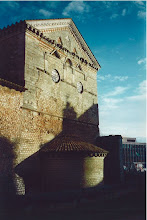
Exterior of Baptistery of St. John, Poitiers, France, dating from 4th Cent., photo © 1995 by me

A belief that the Son of God is Son in name only and not in nature, is not the faith of the Gospels and of the Apostles. If this be a mere title, to which adoption is His only claim; if He be not the Son in virtue of having proceeded forth from God, whence, I ask, was it that the blessed Simon Bar-Jona confessed to Him, Thou art the Christ, the Son of the living God [St. Matt. xvi. 16.] ? Because He shared with all mankind the power of being born as one of the sons of God through the sacrament of regeneration? If Christ be the Son of God only in this titular way, what was the revelation made to Peter, not by flesh and blood, but by the Father in heaven? What praise could he deserve for making a declaration which was universally applicable? What credit was due to Him for stating a fact of general knowledge? If He be Son by adoption, wherein lay the blessedness of Peter’s confession, which offered a tribute to the Son to which, in that case, He had no more title than any member of the company of saints? The Apostle’s faith penetrates into a region closed to human reasoning. He had, no doubt, often heard, He that receiveth you receiveth Me, and He that receiveth Me receiveth Him that sent Me [St. Matt. x. 40. ]. Hence he knew well that Christ had been sent; he had heard Him, Whom he knew to have been sent, making the declaration, All things are delivered unto Me of the Father, and no one knoweth the Son but the Father, neither knoweth any one the Father save the Son [St. Matt. xi. 27.]. What then is this truth, which the Father now reveals to Peter, which receives the praise of a blessed confession? It cannot have been that the names of ‘Father’ and ‘Son’ were novel to him; he had heard them often. Yet he speaks words which the tongue of man had never framed before:—Thou art the Christ, the Son of the living God. For though Christ, while dwelling in the body, had avowed Himself to be the Son of God, yet now for the first time the Apostle’s faith had recognised in Him the presence of the Divine nature. Peter is praised not merely for his tribute of adoration, but for his recognition of the mysterious truth; for confessing not Christ only, but Christ the Son of God. It would clearly have sufficed for a payment of reverence, had he said, Thou art the Christ, and nothing more. But it would have been a hollow confession, had Peter only hailed Him as Christ, without confessing Him the Son of God. And so his words Thou art [cf. Exodus iii. 14.] declare that what is asserted of Him is strictly and exactly true to His nature. Next, the Father’s utterance, This is My Son, had revealed to Peter that he must confess Thou art the Son of God, for in the words This is, God the Revealer points Him out, and the response, Thou art, is the believer’s welcome to the truth. And this is the rock of confession whereon the Church is built. But the perceptive faculties of flesh and blood cannot attain to the recognition and confession of this truth. It is a mystery, Divinely revealed, that Christ must be not only named, but believed, the Son of God. Was it only the Divine name; was it not rather the Divine nature that was revealed to Peter? If it were the name, he had heard it often from the Lord, proclaiming Himself the Son of God. What honour, then, did he deserve for announcing the name? No; it was not the name; it was the nature, for the name had been repeatedly proclaimed.

This faith it is which is the foundation of the Church; through this faith the gates of hell cannot prevail against her. This is the faith which has the keys of the kingdom of heaven. Whatsoever this faith shall have loosed or bound on earth shall be loosed or bound in heaven. This faith is the Father’s gift by revelation; even the knowledge that we must not imagine a false Christ, a creature made out of nothing, but must confess Him the Son of God, truly possessed of the Divine nature. What blasphemous madness and pitiful folly is it, that will not heed the venerable age and faith of that blessed martyr, Peter himself, for whom the Father was prayed that his faith might not fail in temptation; who twice repeated the declaration of love for God that was demanded of him, and was grieved that he was tested by a third renewal of the question, as though it were a doubtful and wavering devotion, and then, because this third trial had cleansed him of his infirmities, had the reward of hearing the Lord’s commission, Feed My sheep, a third time repeated; who, when all the Apostles were silent, alone recognised by the Father’s revelation the Son of God, and won the pre-eminence of a glory beyond the reach of human frailty by his confession of his blissful faith! What are the conclusions forced upon us by the study of his words? He confessed that Christ is the Son of God; you, lying bishop of the new apostolate, thrust upon us your modern notion that Christ is a creature, made out of nothing. What violence is this, that so distorts the glorious words? The very reason why he is blessed is that he confessed the Son of God. This is the Father’s revelation, this the foundation of the Church, this the assurance of her permanence. Hence has she the keys of the kingdom of heaven, hence judgment in heaven and judgment on earth. Through revelation Peter learnt the mystery hidden from the beginning of the world, proclaimed the faith, published the Divine nature, confessed the Son of God. He who would deny all this truth and confess Christ a creature, must first deny the apostleship of Peter, his faith, his blessedness, his episcopate, his martyrdom. And when he has done all this, he must learn that he has severed himself from Christ; for it was by confessing Him that Peter won these glories.

Do you think, wretched heretic of today, that Peter would have been the more blessed now, if he had said, ‘Thou art Christ, God’s perfect creature, His handiwork, though excelling all His other works. Thy beginning was from nothing, and through the goodness of God, Who alone is good, the name of Son has been given Thee by adoption, although in fact Thou wast not born from God?’ What answer, think you, would have been given to such words as these, when this same Peter’s reply to the announcement of the Passion, Be it far from Thee, Lord; this shall not be, was rebuked with, Get thee behind Me, Satan, thou art an offence unto Me [St. Matt. xvi. 22, 23.]? Yet Peter could plead his human ignorance in extenuation of his guilt, for as yet the Father had not revealed all the mystery of the Passion; still, mere defect of faith was visited with this stern condemnation. Now, why was it that the Father did not reveal to Peter your true confession, this faith in an adopted creature? I fancy that God must have grudged him the knowledge of the truth; that He wanted to postpone it to a later age, and keep it as a novelty for your modern preachers. Yes; you may have a change of faith, if the keys of heaven are changed. You may have a change of faith, if there is a change in that Church against which the gates of hell shall not prevail. You may have a change of faith, if there shall be a fresh apostolate, binding and loosing in heaven what it has bound and loosed on earth. You may have a change of faith, if another Christ the Son of God, beside the true Christ, shall be preached. But if that faith which confesses Christ as the Son of God, and that faith only, received in Peter’s person every accumulated blessing, then perforce the faith which proclaims Him a creature, made out of nothing, holds not the keys of the Church and is a stranger to the apostolic faith and power. It is neither the Church’s faith, nor is it Christ’s.

St. Hilary of Poitiers (c. 355 AD) [bold emphasis mine].

Wednesday, May 23, 2007

Update

I regret to say that Pentecost this year will likely come and go without me being Chrismated . . . I'll keep readers posted as to when (God willing!) this event for which I yearn will take place.

Thanks to you all for your comments about Saints' names, they are deeply appreciated and will be thought on.

Pax

-H

Saturday, May 19, 2007

Leftovers

Fr. Jonathan Tobias continues to hit the raw nerves, in a good way, to our spiritual benefit.

Leftovers

Monday, May 14, 2007

Reader Poll - Still on hiatus, however

Dear readers who are Orthodox Catholic Christians -

Due to some potential circumstances, I may move up chrismation from a rather hazy "sometime next year, maybe Theophany or Pascha" to Pentecost of this year. I've sort of put off the Saint's name decision a bit, but if it IS going to be happening on Pentecost this year, then I've got to sort that out.

Understanding that it is a personal decision, I would like your input nevertheless. You need not remind me that it is my decision in consult with my spiritual father, priest and bishop (thank you very much!). Just your unvarnished opinions.

Here are the candidates, with a few pros and cons, in no particular order:

1. Ephrem or Ephraim - in honor of St. Ephrem of Syria


I need not spill a lot of ink about the pros of this Saint - one of the first icons I acquired other than that of Christ was this Saint's icon. I also have found Bishop Theophan's selections of his writings in A Spiritual Psalter to be a most rewarding devotional again and again for development of compunction and realistic outlook - the pure air of faith. Unfortunately (for me) I gave away my copy to another catechumen and have yet to spring for the $28 to replace it.

On a practical note, Ephrem as a Saints name is close enough to 'Eric' to not cause too much jarring upon hearing it and people could get used to it quickly. On the con sides of practicality are the questions of whether to make it 'official' with the governing folks.

2. Hilarion, Ilarion, Hilarius, Hilary, Hilaire - in honor of St. Hilary of Poitiers.


I've used this as a nom-du-plume in the Latin form for some time now, so I'm sure many of you have gotten used to it. However, as I've joked, I'm not sure what the parishioners would think as I introduce myself as 'Hilarius' to the newcomers. The Greek form of Hilarion/Ilarion is perhaps better, but Hilary was no Greek. The English form 'Hilary' is now relegated to a woman's name in popular usage. All of that said, I am convinced that I wouldn't have found Orthodoxy if I hadn't gone to Poitiers and visited his old see, and viewed the very baptismal chapel where the Saint would have immersed those to be illumined. Moreover, he is a Western Saint, and thus gives us the constant reminder that, despite the schism, Orthodoxy is part of our heritage in the West as well.

3. Procopius - in honor of the German Catholic Procopius who became an Orthodox and the first fool-for-Christ in Russia or in honor of the Holy Great Martyr Procopius, the Roman Soldier who was martyred in 303 in Jerusalem, both celebrated July 8.

Procopius was born in Jerusalem of a father who was a Christian and a mother who was a pagan. At first, his name was Neanias. Following the death of his father, the mother raised her son completely in the spirit of Roman idolatry. When Neanias matured, Emperor Diocletian saw him and, at once, took a liking to him and brought him to his palace for military service. When this nefarious emperor began to persecute Christians, he ordered Neanias to go to Alexandria with a garrison of soldiers and there to exterminate the Christians. But, on the road, something happened to Neanias similar to that which happened to Saul [Paul]. In the third hour of the night there was a strong earthquake and, at that moment, the Lord appeared to him and a voice was heard: "Neanias, where are you going and against whom are you rising up?" In great fear, Neanias asked: "Who are You Lord? I am unable to recognize You." At that moment, a glowing cross as if of crystal appeared in the air and from the cross there came a voice saying: "I am Jesus, the crucified Son of God." And further, the Lord said to him: "By this sign that you saw, conquer your enemies and My peace will be with you." That experience completely turned him around and changed the life of Commander Neanias. He issued an order to make the same kind of cross which he saw and instead of going against the Christians he, with his soldiers, turned against the Agarians who were attacking Jerusalem. He entered Jerusalem as a victor and declared to his mother that he is a Christian. Being brought before the court, Neanias removed his commander's belt and sword and tossed them before the judge thereby showing that he is only a soldier of Christ the King. After great tortures he was cast into prison where the Lord Christ, again, appeared to him, baptized him and gave him the name Procopius. One day twelve women appeared before his prison window and said to him: "We too are the servants of Christ." Accused of this they were thrown into the same prison where St. Procopius taught them the Faith of Christ and particularly about how they will receive the martyr's wreath. For that reason in the marriage ritual of the betrothed, St. Procopius is mentioned along with the God-crowned Emperor Constantine and Empress Helena. After this, those twelve women were brutally tortured. Witnessing their suffering and bravery, the mother of Procopius also believed in Christ and all thirteen were slain. When St. Procopius was led to the scaffold, he raised his hands toward the east and prayed to God for all the poor and misfortunate, orphans and widows and especially for the Holy Church that it may grow and spread and that Orthodoxy shine to the end of time. And to Procopius there was a reply from heaven that his prayers were heard after which he joyfully laid his head under the sword and went to his Lord in eternal joy. St. Procopius honorably suffered in Caesarea in Palestine and was crowned with the glorious wreath of immortality on July 8, 303 A.D.

Saint Procopius was a German Catholic. He was running a merchant business in Novgorod when he became enraptured by the beauty of the Orthodox services. He converted into Orthodoxy, gave his wealth and possessions to the indigent and became a monk at the Saint Varlaam-of-Khutyn monastery outside Novgorod. After some time shunning from fame he left for Ustiug where Procopius chose to accomplish the ordeal of God’s fool pretending to be a fool in order to attain utmost humbleness and humility. Thus he became the first fool-for-Christ-sake in Russia. He had to go through many afflictions accomplishing this hard feat. Carrying three wooden staffs he walked barefoot and poorly dressed all year round. He slept on church porches or simply on the ground. He would take alms from the compassionate simple people, but he would never accept any charity from the rich, whom he considered obtained their possessions by unrighteous ways; even though this would cause him to go hungry for several days.

So - pros and cons - the Saint's day is my birthday; Procopius Fool-for-Christ was a German Catholic; my ancestors were from probably Stadlohn in Westphalia and although we think of them as Dutch, they were probably Low German speakers who became connected to the Dutch through the colonialization of North America and the aftermath of the 30 Years War. Great Martyr Procopius was a soldier who was willing to turn in his belt rather than persecute Christians. Downsides are practical - Procopius is a rather uncommon name to borrow and comes with all the risks of being taken for Uberfromm (a la Ochlophobist's articles on that subject) and simply being taken as 'weird' by the family and friends, perhaps detrimentally. I am (alas) no Fool-for-Christ as yet and perhaps too weak of character to take as patron a Great Martyr such as Procopius the soldier.

4. John - in honor of St. John of Damascus; or possibly St. John the Hutdweller.

At one time I had considered John the Hutdweller, for story of his unrecognized sojourn outside his parents house as a hermit which was only revealed after his death when a gold-bound bible that his parents gave him was discovered on him. I have since leaned for the more well known St. John of Damascus for his greater influence in my Orthodox journey - his Exact Exposition of the Orthodox Faith I refer to frequently for my own correction, his influence on the hymnology of the Church is unquestioned, and he spent his life in discourse with Arab culture, which I have found to be my lot for the past 2+ decades. Although raised in privilege, he did not lack for humility in the end. As a practical matter, my middle name is John and, if you have visited my side blog you will know that John or Johannes is a very common name among my ancestors in this country over several generations.

As you can see, I'm leaning to this selection . . . however that may be just being overly conservative - and there are a lot of 'Johns' in the world. And I shall have to retire the nom-du-plume, I'm afraid (sorry folks).

Thoughts???

Thursday, May 10, 2007

Travel Writing - or about how I'm on hiatus

With great relish I picked up a hard-cover copy of John Lloyd Stephens' Incidents of Travel in Egypt, Arabia Petraea, and the Holy Land from Powell's. You can download a copy of this book for free from Google Books, but there's something great about having such a book for real. He published this book under the pseudonym of George Stephens.

I've read a few segments of this book, and can already tell this will be a great delight. [fn1] Stephens was born in about 1806 in New Jersey and grew up in old Knickerbocker New York. He became a lawyer (actually, his education before the age of 13 was simply breathtaking [fn 2]) and was involved in politics a bit before he had trouble with his voice (some form of Strep, perhaps) and determined on physician's advice that a bit of travel to Europe might do him good.

Thus he launched on some extraordinary travels around 1834-1836 through Eastern Europe (including Greece and Russia), Egypt, and the Holy Lands. Later his travels would take him to the Yucatan where, wandering in the Jungle he would run across the Mayan ruins and report them to the English speaking world in great detail. Even later, he became Vice President and the President of the trans-Panama Railroad.

Thus, Stephens represents an interesting intersection of the passing Dutch colonial influence in America, the rise of industrialism and increased opportunities in commerce, the last throes of the Russian and Ottoman empires and the beginning of the waning of centuries-old ways of life in the Middle East. He comes from American Protestant piety, but crosses paths with Orthodoxy, Catholicism, Islam, and Judaism.

I will report back later on some observations about Stephens in relation to another Middle East travel writer, William Darymple.

Anyway, if you want a summer reading project, and you like travel writing . . . join the fun!

In the meantime, I may post a bit at my companion 'blog, but I'm pretty much on hiatus here.

Pax

- H

fn 1: Here is a snippet to whet your appetite: On the afternoon of the ____ December, 1835, after a passage of five days from Malta, I was perched up in the rigging of an English schooner, spyglass in hand, and earnestly looking for the "Land of Egypt." The captain had never been there before; but we had been running several hours along the low coast of Barbary, and the chart and compass told us that we could not be far from the fallen city of Alexander. Night came on, however, without our seeing it. The ancient Pharos, the Lantern of Ptolemy, the eighth wonder of the world, no longer throws its light far of the bosom of the sea to guide the weary mariner. Morning came, and we found ourselves directly opposite the city, the shippping in the outward harbor, and the fleet of the pasha riding at anchor under the walls of the seraglio, carrying me back in imagination to the days of the Macedonian conqueror, of Cleopatra and the Ptolemies . . . In half an hour I was ahore, and the moment I touched it, just as I had found at Constantinople, all the illusion of the distant view was gone.

fn 2: He entered the Classical School in 1815 at the age of 10 to prepare for Columbia College. The headmaster informed his father: "While your son remains here, he will be exercised in Latin and Greek composition; the higher he gets the more he will have of it." The curriculum also included history, analytical arithmetic, mechanics and chemistry, but classics were the heart of it.

He was admitted to Columbia College at 13, as secondary school didn't really exist. Admission was by examination, under the following regulation: "No student shall be admitted into the lowest class of Columbia College unless he be accurately acquainted with the grammar of both the Greek and Latin tongues . . . he is to be examined upon: Caesar's Commentaries, the Orations of Cicero against Catiline, the Oration for the Poet Archias, the Oration for Marcus Marcellus; he is to know the first eight books of Virgil's Aeneid; the first five books of Livy; of the Gospel according to Luke and St John and the Act of the Apostles; of Dalzel's Collectanea Graeca Minora; of the first three books of Xenophon's Cyropaedia and the first three books of Homer's Iliad. He shall also be able to translate English into grammatical Latin, and shall be versed in the first four rules of arithmetic, the rule of three direct and inverse, decimal and vulgar fractions, with Algebra as far as the end of simple equations and with modern geography. The classical examination to be ad aperturam libri [from the opening of the book - e.g., from whatever portion of the text they open the book to]" - Quote from Introduction to Incidents of Travel in Egypt, Arabia Patraea and the Holy Land, introduction by Victor, Wolfgag von Hagen, University of Oklahoma Press 1970 ISBN 0-8061-0886-X

Oh to have such an education by 43 let alone by 13!

Tuesday, May 08, 2007

St. Photini the Samaritan Woman


Saint Photini


Samaritans c. 1900 by Palestine Exploration Fund, 1901-1906 Jewish Encyclopedia

I've been musing on something about Saint Photini, the Samaritan Woman at Jacob's Well (St. John's Gospel, Chapter 4).

Without at all denying the truth of St. Photini's irregular marital status, the fact of the number of 'husbands' and the one living with her who is not a husband is 5 and 1 respectively gives me pause to wonder.

Numerical information like this can often be quite important, indicating a deeper spiritual meaning. I DO NOT CLAIM that this IS the case with the story of St. Photini. But it's possible.

The Samaritans had their own version of the Pentateuch which may represent an earlier (pre-Babylonian captivity) text of the Law. While this bears some more sleuthing (please note that the Wikipedia article is a reprint of the text of a Bible Dictionary . . . there may be more recent scholarship in this area), it is interesting to note that the Samaritan text reportedly follows the Septuagint text in most respects (it notably diverges about the whole Mt. Gerezim/Jerusalem question). A copy of this text was brought west in the 1600s by a Calvinist turned Catholic who ended up rejecting the Masoretic Text the Protestants were adopting in favor of the Septuagint . . . and also rejecting Calvinist viewpoints.

Anyway, 5 husbands, five books of the Law? Last one she has been living with not a husband, could this refer to the Samaritan's capitulation in the Hellenistic period, that they allowed their temple at Mt. Gerezim to be dedicated to Zeus? Or something else? Some commentators have seen in the 5 husbands a connection to the 5 nations, with their gods, that were reputed to be the foundation of the Samaritans, and those commentators suggest that the unmarried one is the LORD.

[Update: But Blessed Augustine says of this

And the Lord said to her, “Thou hast well said, I have not a husband.” How then didst Thou say, “Call thy husband”? Now hear how the Lord knew well that she had not a husband. “He says to her,” etc. In case the woman might suppose that the Lord had said, “Thou hast well said, I have not a husband,” just because He had learned this fact of her, and not because he knew it by His own divinity, hear something which thou hast not said: “For thou hast had five husbands, and he whom thou now hast is not thy husband; this thou hast said truly.”

Once more He urges us to investigate the matter somewhat more exactly concerning these five husbands. Many have in fact understood, not indeed absurdly, nor so far improbably, the five husbands of this woman to mean the five books of Moses. For the Samaritans’ made use of these books, and were under the same law: for it was from it they had circumcision. But since we are hemmed in by what follows, “And he whom thou now hast is not thy husband,” it appears to me that we can more easily take the five senses of the body to be the five former husbands of the soul. For when one is born, before he can make use of the mind and reason, he is ruled only by the senses of the flesh. In a little child, the soul seeks for or shuns what is heard, and seen, and smells, and tastes, and is perceived by the touch. It seeks for whatever soothes, and shuns whatever offends, those five senses. At first, the soul lives according to these five senses, as five husbands; because it is ruled by them. But why are they called husbands? Because they are lawful and right: made indeed by God, and are the gifts of God to the soul. The soul is still weak while ruled by these five husbands, and living under these five husbands; but when she comes to years of exercising reason, if she is taken in hand by the noble discipline and teaching of wisdom, these five men are succeeded in their rule by no other than the true and lawful husband, and one better than they, who both rules better and rules for eternity, who cultivates and instructs her for eternity. For the five senses rule us, not for eternity, but for those temporal things that are to be sought or shunned. But when the understanding, imbued by wisdom, begins to rule the soul, it knows now not only how to avoid a pit, and to walk on even ground—a thing which the eyes show to the soul even in its weakness; nor merely to be charmed with musical voices, and to repel harsh sounds; nor to delight in agreeable scents, and to refuse offensive smells; nor to be captivated by sweetness, and displeased with bitterness; nor to be soothed with what is soft, and hurt with what is rough. For all these things are necessary to the soul in its weakness. Then what rule is made use of by that understanding? Not one to discern between black and white, but between just and unjust, between good and evil, between the profitable and the unprofitable, between chastity and impurity, that it may love the one and avoid the other; between charity and hatred, to be in the one, not to be in the other.

This husband had not yet succeeded to those five husbands in that woman. And where he does not succeed, error sways. For when the soul has begun to be capable of reason, it is ruled either by the wise mind or by error: but yet error does not rule but destroys. Wherefore, after these five senses was that woman still wandering, and error was tossing her to and fro. And this error was not a lawful husband, but a paramour: for that reason the Lord saith to her, “Thou hast well said, I have not a husband. For thou hast had five husbands.” The five senses of the flesh ruled thee at first; thou art come to the age of using reason, and yet thou art not come to wisdom, but art fallen into error. Therefore, after those five husbands, “this whom thou now hast is not thy husband.” And if not a husband, what was he but a paramour? And so, “Call,” not the paramour, but “thy husband,” that thou mayest receive me with the understanding, and not by error have some false notion of me. For the woman was still in error, as she was thinking of that water; whilst the Lord was now speaking of the Holy Ghost. Why was she erring, but because she had a paramour, not a husband? Put away, therefore, that paramour who corrupts thee, and “go, call thy husband.” Call, and come that thou mayest understand me.

“The woman saith unto Him, Sir, I see that thou art a prophet.” The husband begins to come, he is not yet fully come. She accounted the Lord a prophet, and a prophet indeed He was; for it was of Himself He said, that “a prophet is not without honor, save in his own country.” Again, of Him it was said to Moses, “A Prophet will I raise up to them of their brethren, like unto thee.” Like, namely, as to the form of the flesh, but not in the eminence of His majesty. Accordingly we find the Lord Jesus called a Prophet. Hence this woman is now not far wrong. “I see,” she saith, “that thou art a prophet.” She begins to call the husband, and to shut out the paramour; she begins to ask about a matter that is wont to disquiet her.

- From his homilies on the Gospel of St. John


I admit - entirely wild speculation. [Update: but I'm gladdened to find that such ideas were not poo-poohed by Augustine, although he takes a different interpretation]. But there is a great deal going on here - baptismal imagery, trinitarian worship (worship of the Father in Spirit and in Truth [Who is the Way, the Truth, and the Life according to St. John?? That would be the Son]), and so much more.

Eh - anyway - something to muse on.

BTW - Samaritans, which now have dwindled and number perhaps 750 or so, are interesting in that they have retained sacrificial Judaic worship of an extremely ancient type - and apparently they used to send their virgins up on Mt. Gerezim for a time in hopes that a virgin would conceive and bring forth the Restorer [see, e.g., John Lloyd Stephens, Incidents of Travel in Egypt, Arabia Petraea, and the Holy Land, Vol 2, p. 308 available at Google Books] - which says something about the naysayers concerning the understanding of the prophetic texts. So we have in the Samaritans, who did not abandon the sacrifices like Rabbinic Judaism, a sort of remembrance of traditions that have otherwise largely died out in the world.

It would be quite a field trip to do what Stephens did, to sojourn with the Samaritans and observe their worship - talk about living history!

Sunday, May 06, 2007

Tag and Memes and other Blog customs

A few days back Mimi tagged me with a 'thinking blogger' nomination which, I believe, requires me to name 5 nominee blogs that make me think.

Since Mimi did the tagging, it seems that I really can't nominate her yet again as a thinking blogger.

I know probably all of these have been nominated by others, but such is the quality of the blogs that I have to note them here:

1. Scrivener

2. John at Notes from a Commonplace Book

3. Mahmood at Mahmood's Den

4. Fr. Tobias at Second Terrace

5. Fr. Stephen Freeman at Glory to God for All Things

I recognize that nominating priests' blogs is a bit silly - they have far more important things to do than to play such games - all I hope from this is that you will visit their blogs and benefit from them. Mahmood Al Yusif is a blogger and free speech advocate from Bahrain - he takes extraordinarily beautiful photos and has much to say about the mood of moderates in the Middle East. One may not agree with all of his views, but one should listen seriously to him and to those who comment on his 'blog from time-to-time . . . it might dispel your current views of the Middle East and remind you, as it did and does me, that things are often much more complex than we often make them out to be.

++++++++++++

John at Notes from a Commonplace Book has also tagged me with the 'four Saints meme' which requires me to list four fave saints [one blessed] with some notes on them, and who I think should be canonized.

1. Hilary of Poitiers - the nom-du-plume is in honor of him, and I credit him with an important role in my arrival at Orthodox Christianity.

2. Saint Photini, the Samaritan Woman at the Well at Sychar - I was received formally into the Catechumenate on the Sunday of the Samaritan Woman last year (after a year of 'unofficial' catechesis including catechesis classes). This is one of the richest texts in the Gospel of John, perhaps in all the Gospels. There are many lessons to be taken out of this Gospel, but I will just mention a couple that I have taken - feel free to slap me down if my thinking is wrong in this:

St. Photini (Equal to the Apostles) was a Samaritan, whose fathers worshipped God by sacrifices at their own mountain rather than at the temple in Jerusalem. She asks Christ about who is right, and he is fairly blut that the Samaritans 'worship what they do not know' but that the Jews worship what they know and that salvation is from the Jews (certainly true in that he is that salvation). In a sense this is an endorsement of what is 'orthodox' and what is not. There is correct worship and correct belief. However, note the movement of the story. The correct worshippers often reject Jesus, but here is the outsider accepting him and becoming a prolific witness, equal to the Apostles, and a martyr for Christ. Note also what Christ does not do: he does not endorse the 'institution' of Samaritan 'church' - but he recognizes individuals who are his own from within that community.

This is how I've come to understand the oft-discussed phrase of Bishop Kallistos: we know where the Church is, but we don't know where fully where She isn't (my paraphrase). This is not to say that institution "X" is possibly "also the Church" qua institution, but rather that individuals who may be in institution "X" may be, like St. Photini, actually one of the Church. Likewise, let us beware that we may find ourselves to be tares that will be separated from the wheat at the end.

3. St. Cyril of Jersusalem - I think his Catechetical Lectures are essential reading, and draw a portrait of early Christianity wherein we can see that modern Orthodoxy, is one faith with that of the Church that brought us the Symbol of Nicea and the canon of the NT.

4. The Blessed and Most Glorious Lady Theotokos - I have a tough relationship to our Lady as a result of my Protestant 'Restoration Movement' upbringing - nevertheless, her importance as the New Eve, as icon of the Church, and exemplar of a humble life in Christ I recognize as crucial and I pray for her intercessions.

Honorable mentions are St. John of Damascus and St. Ephrem the Syrian - and I resoundingly give my 'amen' to John (Terry) Cowan's comments about these Saints - I too have found St. Ephrem's Spiritual Psalter to be sublime and a constant devotional companion. It was hard to leave these two out of the list.

As to who might be canonized . . . I am almost as reticent as John, but if I might really stick my neck out here about someone who is unlikely to be canonized in the near term by the Eastern Orthodox, but who is IMO a true witness to Christ: I'll nominate Fr. Paulos Iskander the Syriac Orthodox Priest who was beheaded in Iraq this past year in retaliation for the Pope's remarks about Islam. He was killed because he was a Christian and was a convenient mark . . . he wasn't even of a community in communion with Rome. I hope that our Lord has received him as a true martyr of the Church and I hold him so - even though he died a member of a communion separated from the Eastern Orthodox. Perhaps one day we shall see the Eastern and Oriental Orthodox, the two great conciliar communions, resolve the issue of how to handle the questions raised at Chalcedon and we shall be restored to complete communion, and perhaps in that day we shall jointly commemorate Fr. Paulos Iskander as a 'New Martyr.'

Finally - I guess I'll tag Mimi with the Saints meme since she seems to not yet have been tagged and I'm interested in her list.

Friday, May 04, 2007

Of Time, Calendars, and the Passage of Years

Note: This is a slightly edited article from my side 'blog Let Us Praise Famous Men

Orthodox Christians, Jews, Muslims, Chinese, and a few others probably have no problem with the general concept of the profusion of possible of dates being the same actual day as a result of the use of different calendars. Our Protestant ancestors were no different, but in our modern United States the calendar is seen as somewhat immutable.

Most of the Christian world operated on the Julian calendar for hundreds of years. Moreover, in early Roman usage New Year commenced on January 1st, but later Christian influences lead to a trend to count the start of the New Year on one of the great feasts - Nativity or Annunciation, or the like. Lady Day, or Annunciation (March 25), became the New Year's Day in Northern Europe during medieval times (in England during the 12th century, earlier on the Continent) and this practice continued in Great Britain until 1752.

Similarly, although the Gregorian Calendar was adopted by the Roman Catholic Church in 1582 and Catholic nations followed Rome within some reasonable time, Protestants didn't necessarily feel compelled to use the New Calendar and some delayed more than others. Obviously such a thing would, at first, smack of 'Popery.' The Old Julian calendar, adopted under Julius Caesar in 46 B.C., calculated the year as 365 1/4 days. This was eleven minutes, fourteen seconds too long, so that by 1582, the calendar and astronomical year were no longer synchronized, and the vernal equinox occurred on March 11. Pope Gregory XIII suppressed ten days to make the equinox fall on March 21. But England and her colonies did not adopt the Gregorian calendar [and change the method of marking the New Year] until September 2, 1752, by which time eleven days had to be deleted.

Thus there is recorded in one of my family's ancestral bibles the following remark:

"1752.--We came over to the new Style,--so that the next 2nd' of Sep'tr, became the 14th' by a Law--"

Many English citizens felt cheated of eleven days' pay by the Royal Decree, and they chanted, "Give us back our eleven days." Ancient British calendar customs were also somewhat unsettled by the revision, and even today Old New Year's and Old May Day are celebrated in some areas. The hawthorn or "may tree," long a fixture of May Day festivities, is now seldom found in bloom on May Day [New Calendar]. Apparently it tends to bloom around Old May Day, May 12. So England and her Thirteen Colonies [and her other possessions] were Old Calendar and Old Style [e.g., Lady Day=New Year's Day] until just a short time before the Revolution.

Because the nations were counting days and years in different ways, and many peoples were to be found in discourse with one another, even in the colonies, we see colonial records in the early 1700s reflecting the effect of differing calendars, such as this will entry:

On the fourth day of February, in the first year of our Sovereign King George of Great Britain, &c., and in the year of our Lord 1714/5 . . .

This is not ambiguous. If you count New Year from Lady Day [Old Style] then February 4 fell in 1714. If you marked the turn of the year from January 1, then it was 1715. Many dates from the early 1700s appear in this manner.

According to one list I've seen, January 1st came to be used again as the start of the year, starting in Venice in 1522. Dates when this change was made in some other countries are:

1544 Germany
1556 Spain, Portugal, Roman Catholic Netherlands
1559 Prussia, Denmark, Sweden
1564 France
1579 Lorraine
1583 Protestant Netherlands
1600 Scotland
1725 Russia
1721 Tuscany
1752 England and colonies

Thus, a Dutch colonial Protestant in English-ruled New Netherland in the late 1600s could be reporting a date according to English custom, or could possibly record according to a different approach without any indication. This can give a historian headaches in trying to establish corroborating information about an event.

Fling in a little Gregorian/Julian confusion and you have a great time.

Finally, take the fact that modern historians may 'interpret' a date and adjust it to New Calendar New Style New Year without annotation and you've got the possibility that more than one reported date is 'correct.'

One mustn't get too wrapped up in this. It's enough to simply note that these issues exist and work with the records as they are - an oddity of history that not everyone looked at the world (for example, the passing of the New Year) in the way we do. I find that delightful.

I also find it delightful to think of New Year being the date of the Annunciation - the breaking forth of the New Creation in the incarnation of Jesus Christ, the Word made flesh. I think my ancestors had the greater wisdom in this.

Thursday, May 03, 2007

Wisdom of the Fathers

In consequence of one of their pastors preaching "heretical doctrines" from the church pulpit, on Sunday, August thirteenth, 1676, "an extraordinary court" was held, and [Deacon] Dirck Wesselse Ten Broeck was one of those to hear the case. They passed judgment in words that carry wisdom to all generations: "Church disagreements should be consumed in the fire of love."

- The Ten Broeck Genealogy: Being the Records and Annals of Dirck Wesselse Ten Broeck of Albany and His Descendants, Compiled by Emma Ten Broeck Runk, New York, De Vinne Press, 1897

[Dirck Wesselse was younger brother to Wessel Wesselse, from whom I descend in a direct line - they were all members of the Dutch Reformed church]

Sunday, April 29, 2007

On Humility, Not Despairing, and the Passions

“I shall tell you something strange, but do not be surprised by it. Should you fail to attain dispassion because of the predispositions dominating you, but at the time of your death be in the depths of humility, you will be exalted above the clouds no less than the man who is dispassionate.”

-- St. Theognostus

from the Antiochian Orthdox Diocese of Los Angeles and the West "Thoughts of the Day"

[Saint Theo-gnostus is, if not mistaken, rendered in English and Saint God-knower. Anyone with enough Greek to help me confirm that? - H]

Friday, April 27, 2007

Side Blog - Let Us Praise Famous Men


New Netherland c. 1650, from Wikipedia Commons

Please visit my new single-subject side blog:

http://letuspraisefamousmen.blogspot.com/

Monday, April 23, 2007

St. George's Day


As deliverer of captives and defender of the poor, healer of the infirm and champion of kings, victorious Great Martyr George intercede with Christ our God, for our souls' salvation.

From the Greek Orthodox Archdiocese Website:

George, this truly great and glorious Martyr of Christ, was born of a father from Cappadocia and a mother from Palestine. Being a military tribune, or chiliarch (that is, a commander of a thousand troops), he was illustrious in battle and highly honoured for his courage. When he learned that the Emperor Diocletian was preparing a persecution of the Christians, Saint George presented himself publicly before the Emperor and denounced him. When threats and promises could not move him from his steadfast confession, he was put to unheard-of tortures, which he endured with great bravery, overcoming them by his faith and love towards Christ. By the wondrous signs that took place in his contest, he guided many to the knowledge of the truth, including Queen Alexandra, wife of Diocletian, and was finally beheaded in 296 in Nicomedia.

His sacred remains were taken by his servant from Nicomedia to Palestine, to a town called Lydda, the homeland of his mother, and then were finally transferred to the church which was raised up in his name. (The translation of the Saint's holy relics to the church in Lydda is commemorated on November 3; Saint Alexandra the Queen, on April 21.)

++++++++++++

I should note that some believe that there was a conflation of two emperors here and that the traditional referral to Diocletian is due to Eusebius only noting Diocletian and Maximian as the instigators of the last great persecution of Christians. However, some of the earliest manuscripts about St. George's martyrdom reflect that a 'Persian' named Dadianus (which may be a corruption of Dacian) which may actually be a reference to one of th junior emperors of the tetrarchy - Galerius (who was from Dacia as that province was demarcated under Diocletian)and Galerius was the Caesar of Asia Minor and the Balkans at that time. Eusebius does not recount for us anything about St. Alexandra, who would have been so famous a martyr herself that one would think he would have remarked on it. We may never know for sure about that part of the story, but that St. George was beheaded for confessing Christ and was an officer in the Roman Legions seems pretty well settled by all accounts. St. George is such a hugely popular saint in the Middle East and in parts of Europe that he rivals St. Nicholas for the amount of folklore about his life and times and attributions to his name.

Thursday, April 19, 2007

Forty Days in the Desert (Of Lent) - Recap

As I promised one visitor and fellow voyager on the Way, I wanted to make a few notes here of what I learned from posting about fasting, esp. in the Old Testament. As the trite expression goes: your mileage may vary.

++++++++++++

1. Fasting never comes without repentance and humbling oneself before God. Put another way, repentance and humility is the purpose of fasting and these go hand-in-hand.

2. Repentance and fasting is also connected intimately with preparation for intense prayer and, in that time of prayer, fasting, and repentance, seeking the will of God and preparing for mission.

3. Repentance and fasting and prayer is purifying to the heart (or as the Greek Fathers would say - the nous when done for proper purposes. This seems to result in 'seeing God' or 'knowing the will of God' much like Daniel seeing the Angel who touches him and who learns about the Messiah. Here I think of the Beatitudes: 'Blessed are the pure in heart, for they shall see God.' An important caveat here . . . you don't do the 'ritual' to see visions, like some sort of shamanic vision quest. Rather, proper God-ward repentance and humility, prayer and fasting simply opens up our hearts. We should not seek visions. That would be an 'improper purpose.'

4. Finally, repentance-fasting-prayer is a God-blessed means by which we might, to our varying abilities, become as Psalm 50 (LXX) says, that 'contrite and humble heart' that God 'will not despise.' Nevertheless, we recognize as Christians that the truly contrite and humble heart was that One who took on our human nature and was willing to suffer death, even death on a cross. Thus we must take as our model in this as in all things our Lord Jesus the Christ, the Only Begotten Word become flesh.

++++++++++++

Having posting 'what I learned' I can only say this is 'book-learnin' as my own efforts at prayer and fasting are as nothing and I struggle and fall, and gains made yesterday often seem swallowed up today. So pray for me, and take my ideas as friendly conversation.

Labels:

Wednesday, April 18, 2007

Rest In Peace - Some thoughts about the Virginia Tech shootings

My friend Douglas Ian over at the Scrivener has posted a fine memorial to the victims of the Virginia Tech shootings which I commend to you.

At the risk of piling on to the media and conversational frenzy about this horrible crime, the whole media circus surrounding the aftermath brought to mind a similar event which touched me personally a decade ago.

In May 1998, at the age of 15, Kip Kinkel shot his father and mother to death and the next day opened fire on classmates in Springfield, Oregon, murdering two and injuring 25.

I grew up in neighboring Eugene, the county seat. I knew some friends from church camp who had attended Thurston High, the school where Kip attended and where he committed his crime. Our team played their team in sports - the usual interdistrict rivalries.

In 1997-98, I served as a bailiff and judicial clerk to a judge in the Circuit Court, my first post law school job. I took a fews days vacation in May of 1998 and on the first day of that vacation, in a hotel room, I chanced to see on the news my coworkers, Sheriff's Deputies I knew that worked the court, and massive media frenzy as young Kip Kinkel was hauled in to be initially arraigned by my judge. His case was subsequently specially assigned to my judge.

Shortly after coming back from vacation, my judge and his judicial assistant (i.e., secretary) both went on vacation. It was then that I got a fair taste of the ravening wolves of media in their frenzy to get information. Because the defense and the prosecution were less than forthcoming with what the media wanted (i.e., more information more often no matter how trivial), they set their minions to phone the judge's chambers to see if some hapless soul could be talked into giving out some tidbit of information. Whilst the others were away, I was the lucky one to get calls such as "Hello! This is [somebody] from CBS Evening News . . . [blah blah]."

In fact, there was a collateral lawsuit over information flow to the press. The judge had signed off on a stipulated agreement between the prosecution and defense to seal the returns on the warrants to search Mr. Kinkel's family house and school locker.

Search warrants are requested by the police on an affidavit of probable cause to search which generally identifies what they're looking for/hope to find in the search desire to seize. The warrant, issued by the judge, will usually direct what the police are authorized to search for and seize. When executed on, the police file a return affidavit showing what they actually seized pursuant to the warrant.

So the representatives of the State (the 'People') and the defense had agreed that it would be prejudicial to the administration of a fair trial for this guy if the speculative affidavits of what the police thought they might find were released into the all-pervasive national media covering the case.

A newspaper didn't think so, or at least argued that the law did not compel those rights and the risks involved to outweigh the rights of the media in its unsleeping quest to get information to the public. To be fair, there are good arguments on both sides, but the media seems to win this question in the US at least as to this sort of thing. This particular question was sorted out after my appointment at the court had ended but I think the newspaper had it's win and they unsealed those court files.

I thought about all of this, and how surreal the media attention can be, as I watched the "Today Show" set up and broadcasting from the Virginia Tech campus this morning, and felt sick as they hauled in a shy-looking female VT student who had the misfortune to also have been a high-school student at Columbine H.S. when those shootings occurred. I wondered if some energized 'go-getter' at the network followed a hot tip that there was such a student and figured it was such a great bit they had to chase it down and get her on camera. Perhaps she volunteered herself, but she didn't seem like the spotlight desiring type, at least for the view moments I could stomach the interview.

I remember Mr. Kinkel coming into court, a thin stripling of a kid. I think it was for his arraignment on a superseding indictment from the Grand Jury (the first arraignment on such cases comes from a DA's Information, but usually they get the Grand Jury to issue the indictment to avoid the otherwise-required probable cause hearing). It may have been for the finding that he was going to be tried as an adult. Whatever that proceeding was for, I just remember distinctly this little child whom you could've pushed over with a feather, his sad and confused eyes, and wondered how it was all possible.

Kinkel later pleaded guilty and was sentenced to several consequetive sentences, totaling 111 years without possibility of parole.

I saw other, less newsworthy murderers in the court that year. The three youths (two boys and a girl) who were involved in the robbery and beating death of the girl's Alzheimer's afflicted grandfather. The plan to 'knock him out' and get his wallet while he veged in front of the TV got out of hand and one of the boys killed him with the old man's own intricately carved wooden cane. Poor man didn't die quickly, tho' - in pain he staggered to the phone and tried to call someone as blood poured from his head. The crime scene photos showed his blood-stained fingerprints smeared across the keypad where he'd dipped his hand in his own blood from his head and then tried to dial. He let the phone down and wandered to his bed, lay down and bled to death in his bed.

Then there was the group of 'street youth' who decided to have a stomping party because they believed one of their friends who claimed that a young man who was camped down by the river had raped her. The young man was sort of a transient, maybe more like a summer hitchhiker/backpacker traveling the I-5 corridor as many do in the finer weather - a 'free soul.' Enraged at the story, the gang of kids went out in the night and invaded his camp and had a boot party on him. He was so wounded he couldn't escape and was still there when they came back several hours later to finish the job in the early morning darkness. Alas, but the girl recanted her rape story. Turns out some of the kids involved in the gang were but 'pretend' street waifs who would be dropped off by their relatively affluent parents for the weekend downtown and picked up later.

There was Compton, a Springfield methamphetamine user, who killed the 3-year-old daughter of his live-in girlfriend. The girl, whose body was found in a grave near Sweet Home in 1997, had been bound, shocked and sexually assaulted. Prosecutors involved in the case called it the worst case of child abuse they had ever seen.

These passed through our court. In our courthouse, there were others as well that year.

There was the truly evil murders by Conan Wayne Hale and Jonathan Wayne Susbauer, who were convicted of murdering Hale's ex-girlfriend, Kristal Bendele, 15; her boyfriend, Brandon Williams, 15; and a friend, Patrick Finley, 13, in 1995. Bendele and Williams were naked, their bodies piled beside a gravel road. Nearby, the body of Finley was dressed in his shorts and T-shirt, Bendele's pants and a rabbit fur coat. Hale and Susbauer blamed each other. Susbauer was sentenced to life in prison as part of a cooperation deal, I believe. There was a lot of testimony the Hale trial about the sexual nature of the crime, how Hale posed his victims with each other before he shot them. It was Brandon Williams, I think, that lay on the log landing for many, many hours before succumbing to death. I watched a little of that trial . . . Hale, unlike Kinkel, seemed malevolent even sitting at his trial.
Hale gained international attention when jail officials taped a conversation he had with a Roman Catholic priest. Catholic officials sued, and the 9th U.S. Circuit Court of Appeals ruled that County officials had violated the Religious Freedom Restoration Act and the Civil Rights Act. Hale was sentenced the same month that Kinkel committed his crimes. Interestingly, I was asked to run an errand for the judge in that case: to deliver the signed and sealed death warrant for Hale to the Sheriff. A little ink sometimes is quite powerful.

But none of these had quite the media-darling impact of a multiple shooting spree at a school, like Kinkel. The national media just fell all over itself for that one.

A lot of ink is getting spilled, and will get spilled, and words spewed onto the airwaves about 'what it all means' and 'how do we avoid this happening.'

Folks - murder happens EVERY SINGLE DAY. Today/Yesterday in Baghdad around 200 people were killed in car bomb attacks. Yet our media will spend countless hours today trying to get the latest tidbit about the VT shootings, a new angle, a new spin. Today 3 Christians in Turkey were found murdered, execution style, in their bible-publishing shop. Of course we can go on and on and on and on.

What it means is that there is evil loose in this world, that we are generally fallen and not 'enlightened.' The VT shootings were a crime and great tragedy. Let us pray for the peace, salvation, and visitation of the families of the honored dead and the repose for those killed, and recovery for the wounded. Let us look at our own deeds and cry 'Lord have mercy!' There is but One who can lead us to where this does not happen, but it is a hard and narrow way.

And let's turn the TV off for a while too.

Rest in peace, fallen of Virginia Tech.

Saturday, April 14, 2007

Despair not


On Not Measuring One’s Progress
In conclusion, I would like to make one more point concerning the theme of transformation. The Holy Fathers counsel us that we are not to try to measure our spiritual progress. Trying to measure our progress can lead to pride on the one hand, and to despair on the other. If we think, "I’m making great progress, I’m becoming holy," we can be sure that we are not making progress, because we are being prideful, and pride separates us from God. On the other hand, if we despair about what seems to be our lack of progress, this despair also separates us from God.

So, let God do the measuring of our progress. Let God be the judge, both of ourselves and of others.

Benjamin Franklin had the practice of counting up and recording all the good deeds he did every day. From a worldly point of view, this might seem to be a good practice; but this is not what we are to do as Orthodox Christians. We are not supposed to count up our virtues and good deeds and then congratulate ourselves, for Christ said, Let not thy left hand know what thy right hand doeth (Matt. 6:3). In fact, we are supposed to do the opposite: we are to look at our own sins. "Grant me to see my own sins, and not to judge my brother," as we say in the Prayer of St. Ephraim. We need to accuse ourselves of our sins, but we should not judge ourselves in the sense of passing a sentence of condemnation. This is an important distinction. Godly self-accusation leads to taking responsibility for our sins so that we can repent of them, make amends when necessary, and ultimately become free of them. Self-condemnation, on the other hand, leads to despair—because, in passing final judgment on ourselves, we are playing God just as surely as when we pass final judgment on our neighbor.

Spiritual transformation, as we have seen, cannot occur without the Grace of the Holy Spirit. The wind bloweth where it listeth, and thou hearest the sound thereof, but canst not tell whence it cometh, and whither it goeth: so is every one that is born of the Spirit (John 3:8). Transformation by the Grace of God is imperceptible at the time that it occurs. We are being changed, but we do not know it. Therefore, we should not attempt to experience states or moments of transformation. Such an attempt can, after all, only lead to pride and delusion. It is ours only to leave behind all that separates us from God, to turn to God with our whole being, and to let God do the rest.

Spiritual transformation is only perceptible in hindsight. One day we may be able to look back and consider how things have become different. Perhaps we will notice that we are no longer enslaved to a particular passion that once held us tightly. Perhaps, although the circumstances of our lives might be even more difficult than they were in the past, we will notice that we are not reacting to them as negatively as we used to, and that we have a greater sense of trust that our lives are in God’s hands. If we notice such things, let us give thanks to God and not take credit ourselves, remembering the words of St. Diadochos: "Only the Holy Spirit can purify the nous." Then, continuing to practice inner watchfulness, let us look more deeply into ourselves, there to discover more hidden and subtle passions, which we must also put to death on the altar of sacrifice for the sake of Christ.

It is a difficult path, this path of continual re-creation into the likeness of Christ, this path of sacrifice that leads to deification. Our Lord has told us: Narrow is the gate, and difficult is the way, which leadeth unto life (Matt. 7:14). But this is the only way we can follow in order to fulfill the true designation of our existence.

Therefore, following the exhortation of the Apostle Paul, let us not be conformed to this age, let us not follow after the fashions of this world, let us not fashion ourselves according to the passions. Rather, let us be transformed, transfigured into new beings through repentance, through the healing and purification of our nous. Through this transformation, may we come to genuinely love God and our neighbor, may we be united with God through His Grace, and may we dwell forever in perfect love with Christ and His saints. Amen.

- Hieromonk Damascene from a 2005 talk

++++++++++++

As I fall and say to myself Get up! Get up! Keep running! These words are helpful to remind me not to sink into despair, which is deadly. So I'm posting them here for my own archival purposes. The end of the week here has turned out to be hard in the despair department.

Thursday, April 12, 2007

For Kamishia's Family

I noticed a comment on an older post - my December 15 post entitled: In Unforeseen Events . . . - by Kamishia who has a son with hypotonia. I ask my regular readers to remember this family in prayer as I can attest to the dark night of struggle, worry, unbidden fears for the future, and sheer exhaustion that such trials can bring to a family. I also know what depths of joy can come of it. Here I offer a few additional things in case Kamishia passes by this way

2 Grace be to you and peace from God our Father, and from the Lord Jesus Christ. 3 Blessed be God, even the Father of our Lord Jesus Christ, the Father of mercies, and the God of all comfort; 4 Who comforteth us in all our tribulation, that we may be able to comfort them which are in any trouble, by the comfort wherewith we ourselves are comforted of God. 5 For as the sufferings of Christ abound in us, so our consolation also aboundeth by Christ. 6 And whether we be afflicted, it is for your consolation and salvation, which is effectual in the enduring of the same sufferings which we also suffer: or whether we be comforted, it is for your consolation and salvation. 7 And our hope of you is stedfast, knowing, that as ye are partakers of the sufferings, so shall ye be also of the consolation.

- St. Pauls 2nd Letter to the Corinthians Ch. 1

In the Orthodox Churches we will be coming up on several deeply meaningful Sunday commemorations in preparation for the celebration of Pentecost - the coming of the Holy Spirit upon the Church. Next Sunday we commemorate the Gospel concerning Jesus post-resurrection encounter with the disciple (believing!) Thomas. We then move on to the Myrrhbearers, and the the paralytic, the Samaritan Woman (the woman at the well, John Ch. 4), and then the Blind Man (John Ch. 9). If you happen to have a chance to go to one of these services - the paralytic or blind man Sunday's esp., Kamishia, I think you will find good words for your heart if you listen carefully.

Update

I intended to also mention that, while very trying to watch, it is also a huge gain in perspective on our little troubles to spend the time to watch My Flesh and Blood and ruminate seriously on what it means to lay down one's life for another. Some may criticize Susan Tom as doing this for herself in a weird sort of way . . . I don't see it.

Synopsis of My Flesh and Blood

[I believe many libraries have this, it may be rented, and Amazon carries it]

In any case, in all things may God be magnified!

Wednesday, April 11, 2007

Bright Week Reading - Paschal Canon Annotated